© 2026 Art in Video Games
Copyright & Content Disclaimer
This website is primarily a research and educational platform. Third-party images and media are used for research, criticism, commentary and documentation, with all rights remaining with their respective owners. Some areas of the website describe professional and consultancy services, and some illustrative imagery may be AI-generated. No affiliation with or endorsement by referenced rights holders is implied. Rights holders may contact the author regarding attribution, correction or removal.

Pac-Man (Namco, 1980)
Pac-Man (1980, Namco) is one of the most recognisable games in arcade history. Its visual identity is remarkably simple: a yellow circular character, four coloured ghosts, a maze and a collection of dots.
Yet this simplicity is precisely what makes the game interesting from a creative perspective.
Rather than relying on detailed graphics, Pac-Man brings together a small number of shapes, sounds and behaviours to create a distinctive experience.
Toru Iwatani, who led the game’s design, developed its central concept around eating rather than shooting. He also sought to create a game that could appeal to a broader audience than the arcade games commonly associated with combat and competition.
In an interview conducted by Susan Lammers in 1985 and published in Programmers at Work (1986), Iwatani described his interest in using images to communicate with people and creating games that could make people happy.
Decades later, during a presentation at the Game Developers Conference in 2011, he returned to these ideas, explaining his approach to the game’s characters, mechanics and intended audience.
Although these accounts were recorded after the game’s development, they provide valuable evidence of how Iwatani understood his creative decisions.

Toru Iwatani (Japan, 1955)
Despite Iwatani’s central role, Pac-Man was not the work of a single individual.
Its development involved a team at Namco responsible for programming, hardware, sound and technical implementation.
This distinction is important when examining creative authorship.
Iwatani can be associated with the game’s conceptual direction, including its emphasis on eating, simplified character design and distinctive enemies. However, these ideas required the contributions of other practitioners to become a functioning game.
The four ghosts provide a particularly interesting example.
Although visually similar, they follow different movement patterns. Blinky generally pursues Pac-Man’s current position, while Pinky attempts to anticipate where the player is heading.
These differences create variation within an otherwise simple environment.
The ghosts therefore acquire distinctive characteristics not only through their appearance but also through their behaviour.
This demonstrates how character identity can emerge from the relationship between visual design, programming and gameplay.
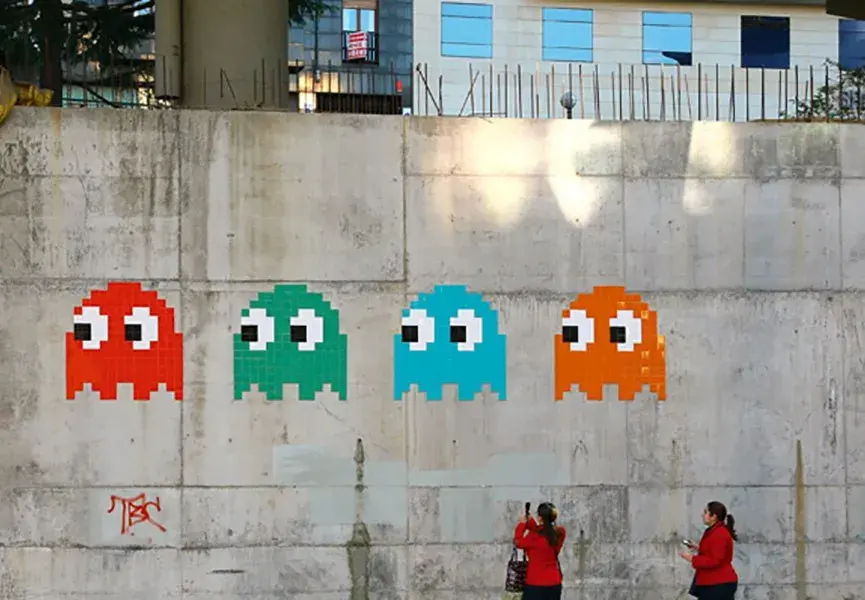
Mural Art by Invader (unknown location / year)
The technological limitations of early arcade hardware encouraged relatively simple graphics. However, these limitations alone cannot explain Pac-Man’s creative identity.
Other games had already explored elements of maze navigation and collection.
For example, Head On (1979, Sega/Gremlin) combined maze-like movement and dot collection with the challenge of avoiding an oncoming computer-controlled vehicle.
Pac-Man did not invent these individual mechanics.
Its distinctive contribution was the particular combination of eating, pursuit, simplified characters and differentiated enemy behaviour.
The resulting design communicates considerable information through a limited visual vocabulary.
Players can recognise the protagonist, understand the environment and distinguish the threats without requiring elaborate graphical representations.
The game’s simplicity was therefore not merely a technological necessity. It also reflected a series of creative decisions about how visual forms and interactive behaviours could work together.
Pac-Man provides an early example of how creative agency can operate through conceptual and visual reduction.
Its significance for this research does not depend on identifying a single author responsible for every aspect of the game.
Instead, it lies in examining how Iwatani’s documented design ideas were developed through collaborative production and expressed in the finished game.
The case demonstrates that creative contributions are not necessarily associated with visual complexity.
Sometimes, they emerge through decisions about what to simplify, what to repeat and how to make small differences meaningful.
Pac-Man illustrates how a limited collection of forms and behaviours can establish a coherent creative identity.
Credits: HollywoodChicago.com Youtube Channel and Press Start Podcast
Interview source: https://www.youtube.com/@gamereactorTV

Head On (1979) — An earlier example of maze navigation and dot collection, providing historical context for Pac-Man’s design.
Final Fantasy (1987) — A contrasting approach to creative agency, examining how elaborate concept illustrations and pixel-based graphics contributed to a game’s visual identity.
Final Fantasy (Square 1987)
Credits: Game Reactor Youtube Channel
Interview source: https://www.youtube.com/@gamereactorTV
Iwatani, Toru. 2011. Pac-Man Creator Iwatani Discusses Female-Friendly Design Lessons. Game Developers Conference presentation, reported by Game Developer.
Lammers, Susan. 1986. Programmers at Work: Interviews with 19 Programmers Who Shaped the Computer Industry. Microsoft Press.
https://programmersatwork.wordpress.com/toru-iwatani-1986-pacman-designer/
Zamora Sanz, Ignacio. 2026. Interview with Susan Lammers, 2 June 2026. Unpublished research interview.
Pac-Man Official Site
https://pacman.com/en/history/
Article at Artsy by Abigail Cain
https://www.artsy.net/article/artsy-editorial-pac-man-arcade-art-gallery
Pac-Man at MoMA
https://www.moma.org/collection/works/164917?artist_id=42596&page=1&sov_referrer=artist
PAC-MAN (1980)
Developer: Namco
Publisher: Namco
Original Platform: Arcade
Genre: Maze / Action
Creative Contributors: Toru Iwatani and the Namco development team
Research Period: 1980–1994